These ideas grew from lived experiences, which are told separately in ‘The Map I Never Needed’.
All lives will one day transition, just as water ultimately flows toward the vast ocean. Even if water evaporates into the air before reaching the ocean, it will eventually condense into clouds, fall again as rain, and continue flowing in new forms. What matters, then, is not merely where the water ends, but how it flows along the way.
The comparison between water and human life is not meant to suggest that human beings are passive substances governed only by physical laws. Human beings possess awareness, memory, emotion, biological needs, social conditions, and varying degrees of agency. The metaphor of water is therefore only a way of illustrating patterns of interdependence, change, influence, and response within life processes.
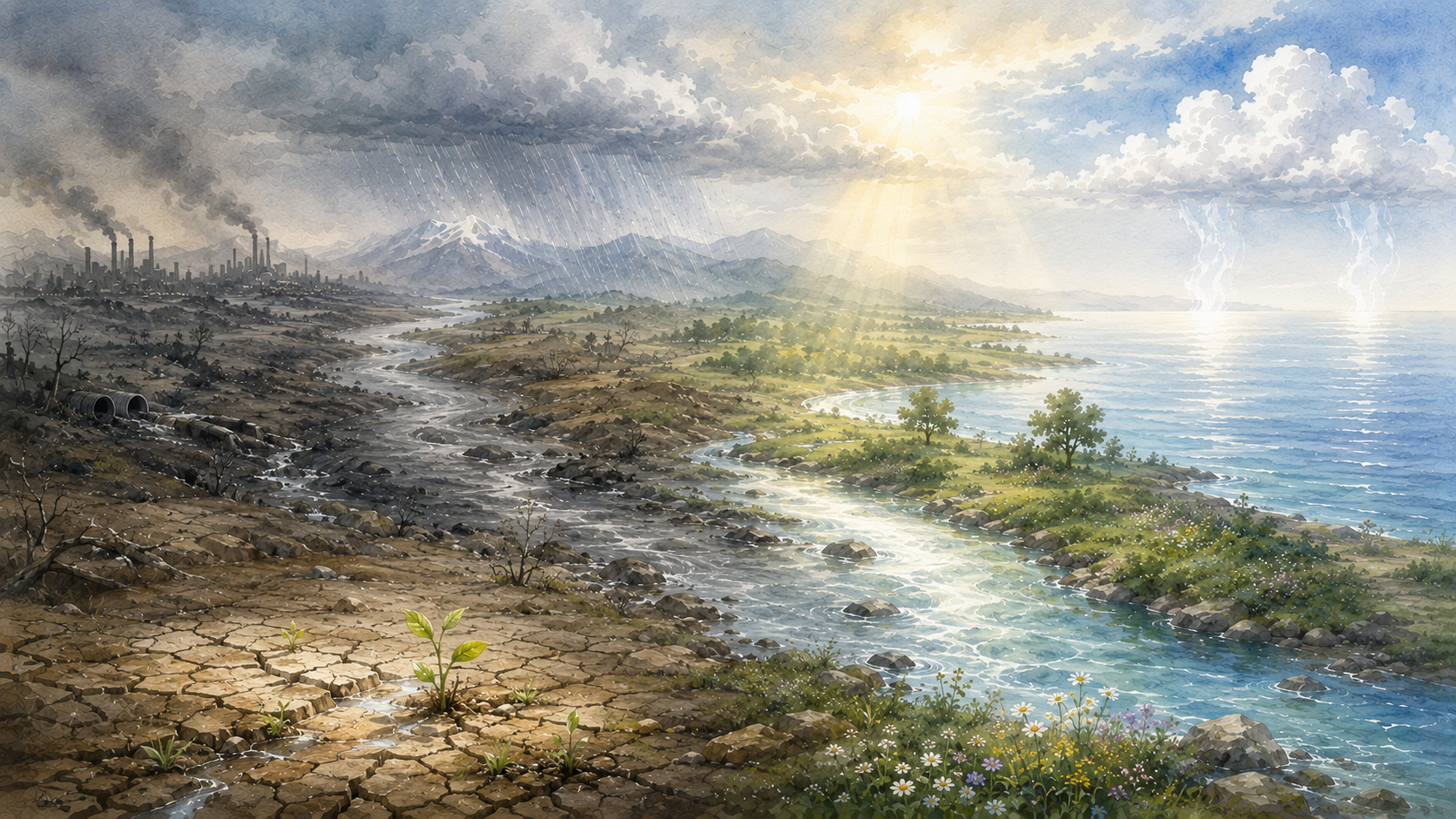
As water moves through the world, it may become polluted through various conditions. Some of these conditions lie beyond one’s control, such as terrain, weather, social systems, trauma, economic circumstances, illness, or external influences flowing into the water. Others arise from responses that may still remain partially influenceable within those conditions: whether disturbance is continually intensified, whether support and healthier influences are introduced, and whether conditions are created that allow clarity to gradually return.
If the water of life becomes polluted, one’s responses alone may not completely remove the pollution. Some forms of suffering require time, support, treatment, social change, or protection from further harm. Yet responses may still influence the degree of suffering, the duration of disturbance, and the possibility of recovery when supportive conditions become available.
Water that remains relatively clear may nourish the lives and environments it touches as it flows. Polluted water, on the other hand, may spread harm to other waters and environments along its course. Yet even polluted water may gradually become clearer again if disturbance lessens and conditions support purification.
Though not sufficient on its own, living with awareness can be a good foundation for living with clarity. It is not enough for us, in the water of life, merely to know where we flow. Clarity also requires understanding patterns of cause and effect: noticing how pollution arises, how disturbance spreads, and what conditions either worsen, sustain or reduce suffering.
Through such understanding, one may gradually learn to reduce unnecessary contact with sources of pollution, introduce healthier influences into the flow, seek help when necessary, or simply avoid further agitation while recovery unfolds. Often, clarity returns not because it is forced, but because harmful conditions are no longer continually reinforced. In this way, water may gradually clear as it flows.
Yet even reaching the ocean is not necessarily an absolute end.
Water flows into the ocean, evaporates, forms clouds, falls as rain, and flows again. Though evaporation distills the water itself, the deep currents of cause and effect carry forward. The legacy of past suffering alters the very terrain of the next cycle—determining whether the returning flow brings nourishing rain or falls as a torrent onto already scarred earth. There is no fixed beginning or ending, only continuous transformation, for better or worse. In the same way, what we call existence is not a static entity but an ongoing process of change. “Living” and “death” are names given to different phases within this process rather than absolute beginnings or endings.
What continues is not a fixed and unchanging identity, but continuity of processes, influences, conditions, and transformations.
Within this ongoing flow of processes, awareness may arise in certain beings. Through awareness, the flow can sometimes be observed directly. When awareness is absent, turbulence and harmful patterns may continue automatically through habit, conditioning, fear, or reaction. When awareness is present, there may be greater possibility for reflection, restraint, learning, adaptation, and more skillful responses.
Awareness does not create absolute freedom from conditions. Human beings are always shaped by biology, history, relationships, social systems, and environments. Yet within these conditions, varying degrees of influence and choice may still emerge. A person may not fully control the river they are in, but they may still influence how they respond within the currents available to them.
Impermanence does not make actions meaningless. On the contrary, because conditions are constantly changing, actions matter precisely because they participate in shaping future conditions — both for oneself and for others connected through shared systems and environments.
All beings move within this continuous process, just as water appears in many forms: rain, streams, rivers, lakes, underground water, and oceans. Each drop of water possesses temporary uniqueness, yet no drop can remain completely separate from the larger whole permanently. Every drop both influences and is influenced by the waters and environments through which it flows.
Human beings are similar. Each person is individually distinct, yet inseparable from humanity, society, and the environments and systems they participate in. No person exists in complete independence permanently.
Because of this interconnectedness, harmful actions do not remain isolated. They spread through relationships, communities, and environments, creating conditions that increase suffering and instability for others and often eventually for the person acting as well. Likewise, clarity, restraint, compassion, wisdom, and care may also spread through interconnected systems, influencing the wider conditions that all beings share.
Ethical responsibility does not require belief in a permanent, unchanging self. Even within a process-based existence, suffering and well-being are still experienced within living systems. Because beings affect one another through interconnected conditions, actions continue to matter regardless of whether identity is fixed or constantly changing.
Thus, every being continuously shapes and is shaped by the processes it moves through.
When applied to our inner lives, this flow suggests a few practical reminders:
• If you are emotionally overwhelmed, pause before reacting. Some disturbances lessen with time, rest, support, and reduced agitation.
• Deeper suffering may also require help, treatment, protection, or long-term healing.
• Pollution is not always your fault, though your responses may still influence what happens next.
• Do not force clarity; first reduce unnecessary disturbance and harmful reinforcement.
• Your actions spread through interconnected lives and environments — choose actions that are more likely to nourish rather than harm.
And when your water gradually becomes clearer again, it may continue to flow — and whatever it touches may also have greater possibility to heal, grow, and live.